
Inclusive design that makes it to Monday's lesson.
Self-paced online PD is coming soon. Explore the courses and try free classroom resources now.
Created by Alana Edwards, a WA teacher and learning support specialist. More about me
Online PD courses
Self-paced professional learning you can do in your own time, with a certificate of completion.
Each course includes the lessons, downloads, activities and a certificate of completion. Prices are in AUD. Both courses together will be $79 once both are available.
-
Coming soon
From Content to Judgement
Building confidence with the WA Curriculum, from what the documents require to making and moderating A–E judgements.
By the end, you'll be able to:
- Tell content descriptions, achievement standards and elaborations apart, and know which are required
- Explain A–E grades as professional judgements of evidence
- Check what an assessment task lets students show, and what other evidence you need
- Run a short moderation conversation about the qualities in student work
Includes a certificate of completion and an evidence pack to help you record it for TRBWA registration.
Introductory price: $39 per teacher
Want it for a group of staff? Groups of 10 are $350 per course. Register interest.
-
Coming soon
Creating Inclusive Resources
Practical resource and task design: spotting the load a resource adds, and simple changes that reduce barriers for students.
By the end, you'll be able to:
- Spot where a resource adds load that isn't part of the learning
- Apply five design principles that reduce barriers
- Use a two-minute check to spot common design barriers
Includes a certificate of completion and an evidence pack to help you record it for TRBWA registration.
Introductory price: $39 per teacher
Want it for a group of staff? Groups of 10 are $350 per course. Register interest.
Free teacher resources
Print-ready resources you can use this week. No email or sign-up needed.
-
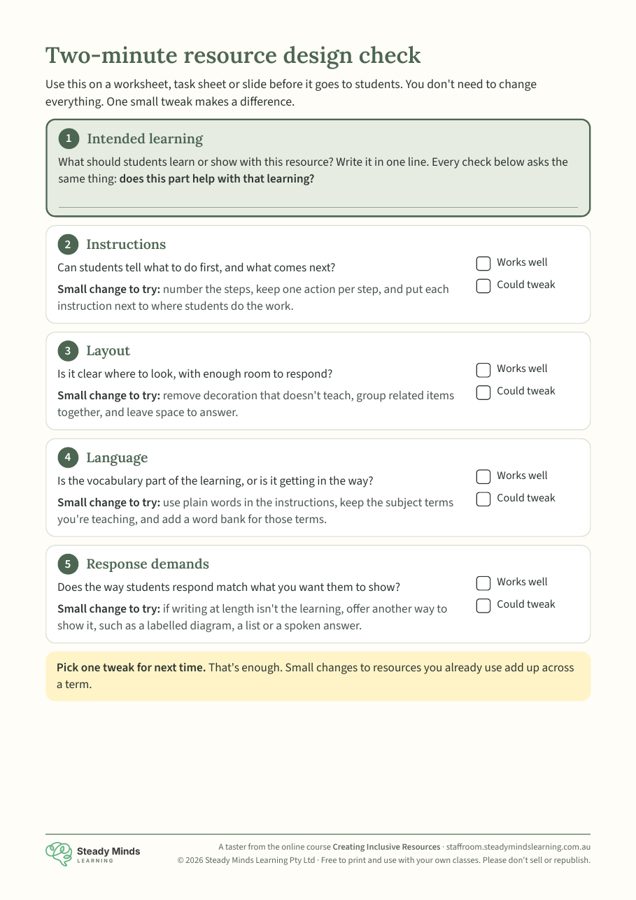
Two-minute resource design check
Five quick checks (intended learning, instructions, layout, language and response demands) with one small change to try for each.
- Suits
- Any teacher, K–12
- When to use it
- Before a worksheet, task sheet or slide goes to students
- Format
- 1 page · A4 portrait
Download free PDF: Two-minute resource design check
Free to print and use with your own classes. Please don't sell or republish.
-
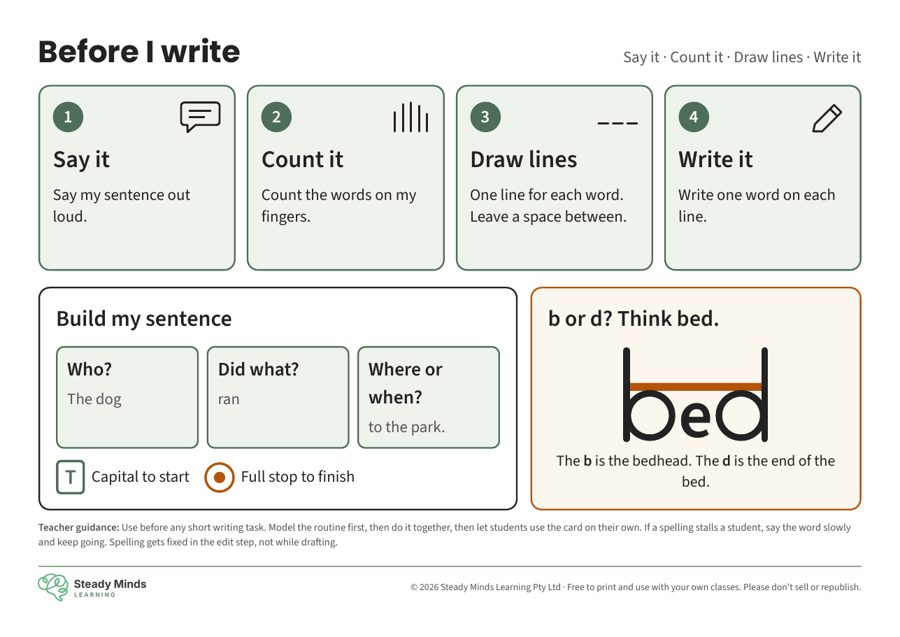
Before I write
A staged routine for getting ideas onto paper: say it, count it, draw lines, write it. Includes brief teacher guidance.
- Suits
- Students in the early years, and anyone who freezes at a blank page
- When to use it
- Before short writing tasks, as a desk card
- Format
- 1 page · A4 landscape
Download free PDF: Before I write
Free to print and use with your own classes. Please don't sell or republish.
-
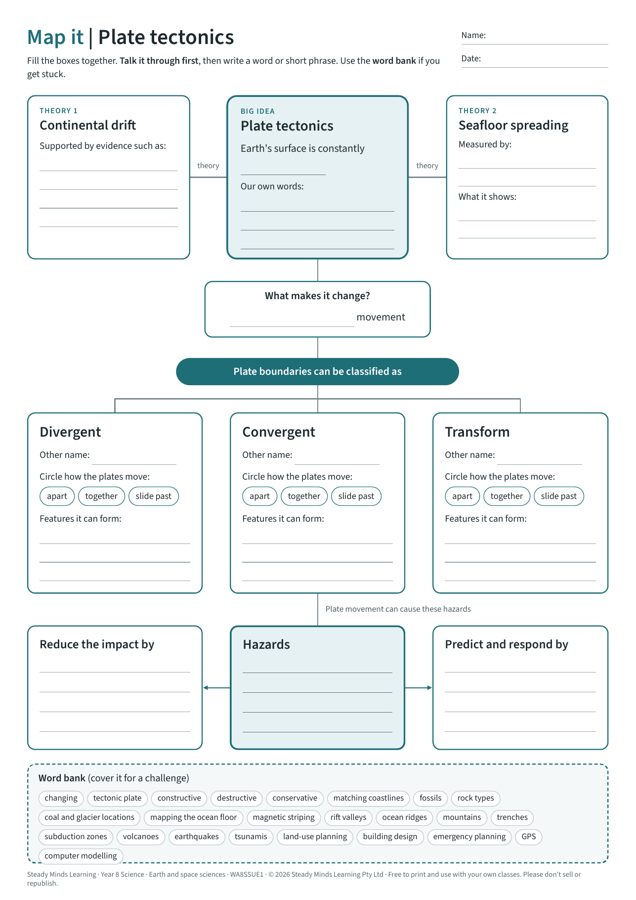
Year 8 Earth Science maps
Two structured concept maps with word banks, so students can show what they know with less writing load.
- Suits
- Year 8 Science
- When to use it
- Revising plate tectonics, and rocks and minerals
- Format
- 3 pages · A3 portrait (2 maps + answer guide)
Download free PDF: Year 8 Earth Science maps
Free to print and use with your own classes. Please don't sell or republish.
Using these resources
You're welcome to print and use these with your own classes, as often as you like. Please don't sell them or upload them elsewhere. If a colleague would find them useful, share the link to this page instead:
Want to learn the thinking behind these tools?
The online PD courses show how and why they're designed this way.
How I work
Three principles shape every resource, course and session I make. Below them is one example of what that looks like in practice.
Three principles
Design for access at the start, not adjustments at the end
Reduce cognitive load that isn't part of what the task assesses
In line with SCSA's principle that assessment should be fair: it assesses what it's meant to assess, against the achievement standard.
Make it workable for a busy teacher, today
In practice: reviewing an assessment task
A short look at how I think through an assessment task: what it's meant to measure, what might get in the way, and what I'd change.
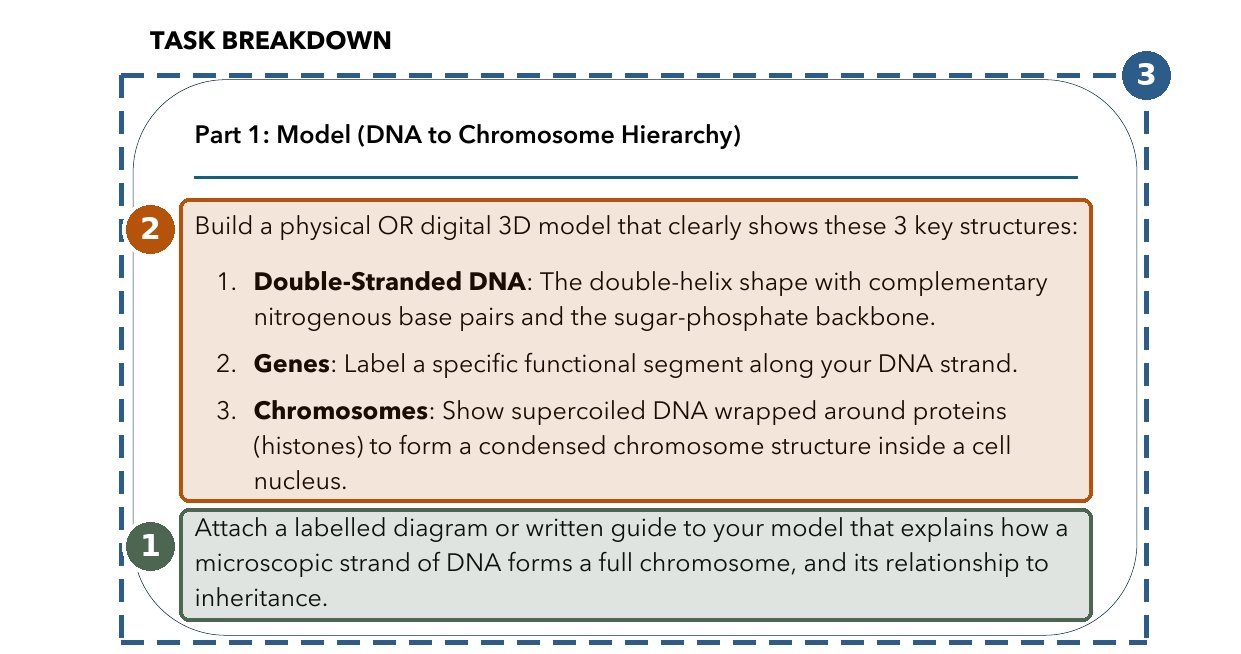
- Intended learning (annotation 1): Students explain the relationship between DNA, genes and chromosomes.
- Possible barriers (annotation 2): Construction demands, access to materials and managing multiple instructions may affect how students demonstrate their understanding.
- What I would change (annotation 3): The task already allows a physical or digital model. Where 3D construction isn't being assessed, I'd add the option of a labelled 2D representation with an explanation. I'd also stage the instructions, and assess scientific accuracy separately from presentation.
An extract from a PD discussion example. Annotations show my review process; this is not a finished assessment for classroom use.
School-based PD
Assessment design and professional learning for school teams, using the tasks, plans and student work you already have.
When school-based sessions open, they'll be delivered in person across Perth metro. Regional and remote visits will be available with a travel charge.
-
Assessment that lets students show what they know
I sit down with your team and we work through the assessment tasks you already use, together. We look for small changes that help more students show what they know.
- Suits
- Learning area teams and heads of learning area
- Format
- An in-person working session with one learning area team, using your own tasks
- Your team leaves with
- A written design brief for each task: what's already working, and simple tweaks for next time
-
Leading moderation in your team
Setting up a moderation routine your team can run on its own, using the student work samples and marking keys you already have.
- Suits
- Heads of learning area, curriculum leaders and teams teaching Years 3–10
- Format
- An in-person PD session, then scheduled check-ins across the term. Pairs with the online course From Content to Judgement.
- Your team leaves with
- A moderation routine that fits into the meetings you already hold, and the confidence to lead it
Register interest
For school-based PD, or online course access for a group of staff. Neither is open yet, but you can register interest now. Tell me a bit about your school and I'll email you when it opens, and talk through what would suit your staff.
About
I'm Alana Edwards, a secondary teacher and learning support specialist with 15+ years in WA classrooms. I know the gap between what a learning plan says and what actually happens in a 50-minute lesson with 31 students. Steady Staffroom is where I share what works in that gap.